Start Your PRE Journey
Assess your platform maturity, explore the PRE framework, or see how AEGIS operationalizes PRE in software.
Platform Reliability Engineering is the discipline of ensuring infrastructure platforms remain reliable, governed, cost-efficient, secure, operable, and continuously improving — as products, not just environments.
Platform Reliability Engineering (PRE) is the discipline of designing, operating, governing, and continuously improving infrastructure platforms to ensure reliability, operational efficiency, governance compliance, and cost optimization at scale.
Where SRE focuses on
Service reliability — ensuring individual services meet SLOs and handle failures gracefully.
PRE focuses on
Platform reliability as a product — encompassing stability, governance, economics, intelligence, and operations maturity.
Each discipline solves a part of the platform operations problem. PRE unifies them at the platform layer.
| Discipline | Primary Focus | Scope | Limitation |
|---|---|---|---|
| SRE | Reliability of services | Service SLOs, error budgets, incident response | Does not govern cost, security, or platform-level decisions |
| Platform Engineering | Developer platform enablement | Internal developer platforms, golden paths, self-service | Focused on developer experience, not operational governance |
| FinOps | Cloud cost governance | Cost visibility, optimization, allocation | Isolated from reliability and security operations |
| Cloud Security | Policy and access control | IAM, compliance, vulnerability management | Siloed from cost, reliability, and operational workflows |
| PRE | Unifies all of the above at the platform operations layer | Reliability + governance + cost + security + intelligence | Requires organizational commitment to platform-as-product thinking |
PRE is not a replacement for SRE, Platform Engineering, FinOps, or Security. It is the operating model that connects them — ensuring reliability, governance, cost control, and security decisions are made together at the platform layer, not in separate silos.
Organizations face structural challenges that no single existing discipline solves. PRE emerges as the unified answer.
6+ disconnected tools creating operational fragmentation, context switching, and knowledge silos.
Manual investigations, configuration fixes, approval workflows, and incident coordination consuming team bandwidth.
Uncontrolled cloud growth, policy violations, shadow infrastructure, and access sprawl.
Idle resources, overprovisioning, unused services, and lack of cost visibility driving unsustainable cloud spend.
Lack of platform health understanding, reliability scoring, risk insights, and data-backed operational decisions.
A practical capability model for organizations building platform reliability maturity.
Platform stability and standardization. Create a consistent platform baseline.
Day-to-day platform reliability. Ensure operational stability.
Governance and risk management. Ensure controlled platform growth.
Proactive platform optimization. Move from reactive to predictive operations.
Core operating principles that govern how PRE organizations think, operate, and evolve.
Design failure tolerance, remove single points of failure, define reliability targets, and engineer recovery paths.
Governance must exist inside provisioning, change, deployment, and platform operations workflows.
Platforms require a roadmap, ownership, SLAs, and experience design. Platform teams operate like product teams.
Manual operations introduce risk. Provisioning, scaling, recovery, governance, and incident response must be automated.
Operational decisions must be data-backed through health scoring, reliability metrics, cost metrics, and risk indicators.
A framework for organizations to assess where they are and chart a path to autonomous platform operations.
Manual operations, limited monitoring, firefighting culture, uncontrolled growth.
High RiskBasic monitoring, defined processes, centralized visibility. Still human-dependent.
Moderate RiskDefined standards, automation introduced, governance processes, platform baselines.
ConsistentPredictive insights, risk detection, cost intelligence, reliability scoring.
PreventiveSystems that continuously detect, prioritize, and drive corrective action.
PRE EvolutionFive standard areas define the measurable requirements for platform reliability engineering.
Organizations adopting PRE can expect measurable improvements across four areas.
Strategic Outcome
Your platform becomes safer, faster, and cheaper to operate.
PRE represents the natural evolution of infrastructure disciplines toward unified, intelligent platform operations.
Reduce toil, automate workflows, and operate platforms with minimal manual intervention.
Continuous cost intelligence and optimization that makes cloud spend controllable and predictable.
Proactive risk detection, faster incident resolution, and governance that prevents problems before they start.
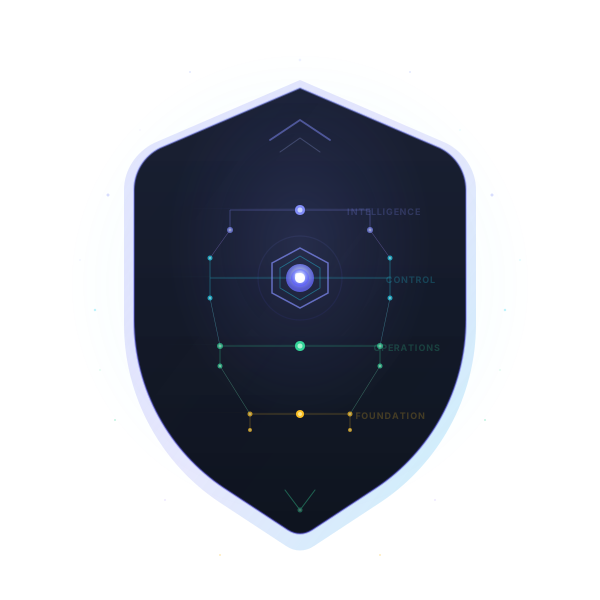
PRE defines the operating model.
AEGIS is the software system built to operationalize it.
Unified platform view
Automated policy control
Safe operational execution
Data-backed decisions
AEGIS does not replace monitoring, security, or cost tools. It sits above them as the operational control layer that connects visibility, governance, and execution — evaluating every operational decision against policy, routing to appropriate authority, and producing an immutable audit record.
Assess your platform maturity, explore the PRE framework, or see how AEGIS operationalizes PRE in software.