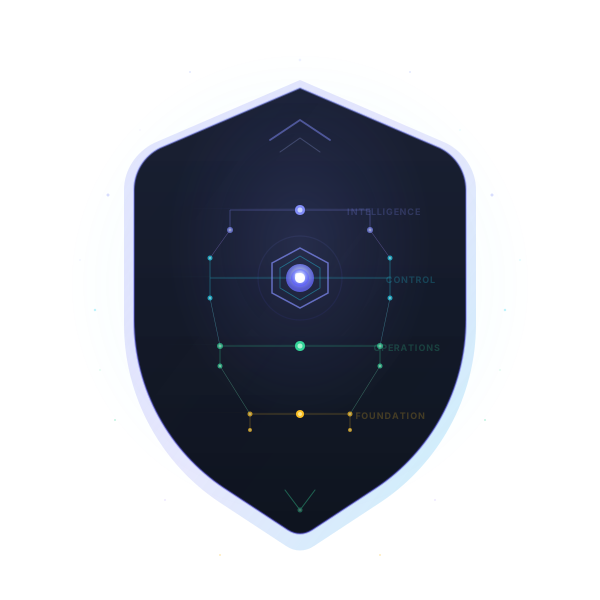
AEGIS Platform Architecture
The Operational Control Plane for Modern Cloud Platforms
Modern platform teams operate across dozens of tools, thousands of resources, and constant change. AEGIS introduces a missing layer in cloud operations: a governed operational control plane that connects visibility, decision-making, execution safety, and continuous improvement.
AEGIS does not replace your tools.
AEGIS makes them work together safely.
What AEGIS Is
AEGIS is the Operational Decision & Governance Layer for Cloud Platforms. It sits between:
Intent
Policy
Decision
Execution
Evidence
Every operational action is
The Four Pillars of AEGIS
KNOW your platform
Understand what exists, what changed, and what matters.
AEGIS builds a continuously updated operational picture across infrastructure, services, cost, and reliability signals.
RUN platform reliably
Detect problems early and respond safely.
AEGIS helps teams identify risk patterns, correlate incidents, and reduce operational noise.
ENFORCE governance safely
Every action follows policy.
Changes are evaluated before execution, ensuring governance is built into operations instead of applied afterward.
IMPROVE continuously
Turn operations into learning.
AEGIS helps organizations measure reliability trends, operational maturity, and improvement over time.
Control Plane Principles
AEGIS is built around principles proven in large-scale platform organizations.
Governance before automation
Automation without governance creates risk. AEGIS ensures automation follows policy.
Evidence before action
Every operation produces verifiable records.
Event-driven architecture
AEGIS connects systems through operational events rather than fragile integrations.
Fail-safe design
Unknown states default to safe outcomes.
Tenant isolation by design
Multi-tenant environments remain securely separated.
AI assists but never decides
AI provides analysis and recommendations. Humans and policy make decisions.
High-Level Architecture
AEGIS is organized into six conceptual layers.
Intake Layer
Connects cloud providers and operational tools. Normalizes data into a unified operational model.
Collects signals from
- ✓ Cloud platforms
- ✓ Observability tools
- ✓ CI/CD systems
- ✓ Security tools
- ✓ Cost systems
Evaluates
- ◆ Policies
- ◆ Risks
- ◆ Changes
- ◆ Signals
- ◆ Approvals
Core Decision Engine
The governance brain of AEGIS. Ensures actions follow organizational standards.
Platform Intelligence
Transforms signals into insight. This layer helps teams move from reactive operations to proactive operations.
Capabilities
- ✓ Incident correlation
- ✓ Pattern detection
- ✓ Risk identification
- ✓ Change impact analysis
- ✓ Reliability trend analysis
AEGIS helps teams
- ✓ Simulate operational changes
- ✓ Understand impact before execution
- ✓ Limit blast radius
- ✓ Enable rollback strategies
- ✓ Enforce approval workflows
Execution Safety
Ensures safe change execution. This reduces operational risk without slowing delivery.
Control Boards
Role-specific operational visibility. AEGIS provides different operational views for every stakeholder.
Platform teams
Operational health, incidents, reliability metrics
Engineering teams
Service health, deployments, error trends
Leadership
Platform health, risk posture, improvement trends
Finance teams
Cost efficiency, waste detection, trend visibility
AEGIS maintains
- ✓ Operational decision history
- ✓ Governance records
- ✓ Execution evidence
- ✓ Compliance mapping
Audit & Evidence Layer
Creates operational accountability. Supporting enterprise governance and regulatory requirements.
Governance Execution Model
AEGIS standardizes how operational decisions are executed.
Intent
Plan
Policy Evaluation
Approval
Safety Validation
Execution
Evidence
Platform Intelligence Capabilities
AEGIS helps teams understand what matters — using data instead of intuition.
What usually causes incidents
What fixes them fastest
What changes introduce risk
Where reliability is improving
Where costs are drifting
Security Architecture
Security is foundational in AEGIS design. AEGIS is designed to support enterprise security programs and compliance initiatives.
- ✓ Strong tenant isolation
- ✓ Short-lived credentials
- ✓ Secure data handling
- ✓ Input validation controls
- ✓ Operational audit trails
- ✓ Governance enforcement
Organizations can extend
- ◆ Policies
- ◆ Workflows
- ◆ Integrations
- ◆ Signals
- ◆ Dashboards
Extension Model
AEGIS is designed to be extensible without customization risk. This allows organizations to adapt AEGIS to their operating model rather than changing their model to fit the tool.
Deployment Philosophy
AEGIS is designed as a modern cloud control plane. The platform is designed to grow with organizational maturity.
Stateless services
Horizontal scalability
Cloud-native architecture
Event-driven communication
Secure multi-tenant model
Why Organizations Adopt AEGIS
They experience
They move toward
The AEGIS Vision
Cloud platforms have monitoring.
They have automation.
They have CI/CD.
They have security tools.
What they lack is a decision layer.
AEGIS provides that missing control plane.
Not another tool.
A platform to make your platform work better.
See AEGIS in Action
AEGIS helps platform teams reduce operational complexity while increasing reliability, governance, and efficiency. Request an architecture walkthrough or design partner discussion.